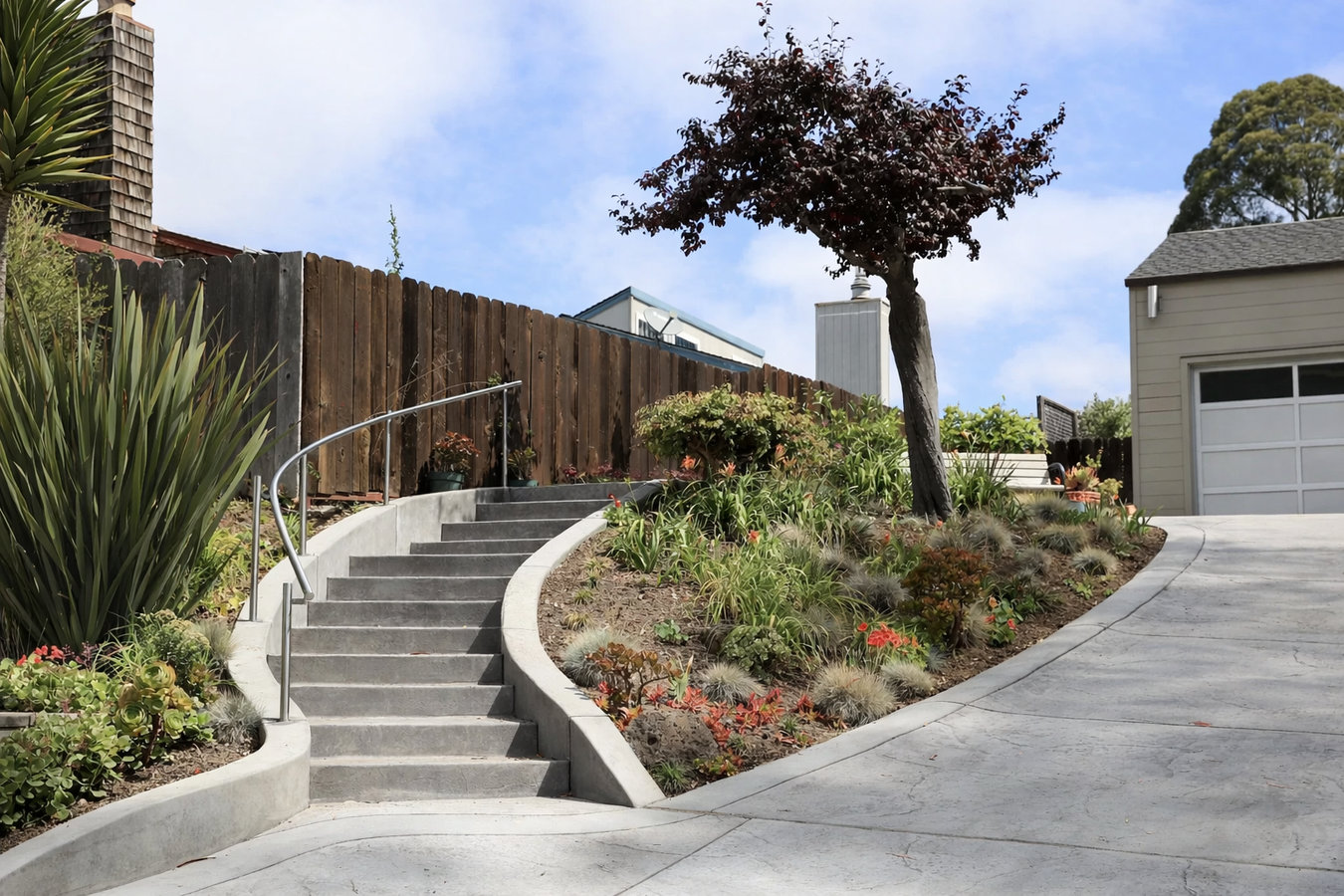
Cracked or tilting steps are a trip hazard and a curb appeal problem. We build concrete steps that hold up to Redlands heat and soil movement for decades.
Concrete steps construction in Redlands takes one to two days of hands-on work for a typical front-entry set - the pour and finishing happen in a single day, with a 24 to 48 hour wait before you can walk on them again.
A significant portion of Redlands homes were built between the 1920s and 1970s, and many of those original concrete steps are now cracked, tilting, or crumbling at the edges. The combination of Inland Empire heat cycles and the clay-heavy soils under older Redlands neighborhoods accelerates wear on steps that were poured without adequate reinforcement. If your entry stairs are showing those signs, patching rarely solves the problem for long. For larger-scale entry and hardscape work, our concrete retaining walls work pairs naturally when you also need to manage a slope near the steps.
Well-built concrete steps can last 30 to 50 years or more. The difference between steps that hold and steps that crack is almost entirely in the preparation: the soil compaction, the gravel drainage layer, and the steel rebar placed inside before the pour.
Cracks wider than a hairline - especially ones that run all the way across a step or down the side - mean the structural integrity is compromised. In Redlands, clay soil movement and summer heat cycles accelerate cracking in older concrete, so a small crack can open significantly within a single season.
If any step shifts when you step on it, or the whole staircase looks like it leans to one side, the base underneath has settled or eroded. This is a safety issue, not just cosmetic - a tilted step is a trip hazard for any guest who is not expecting the unevenness.
When the surface of a step starts to flake, chip, or crumble at the front edge where you place your foot, the concrete is deteriorating from the inside out. In Redlands older homes, this often happens in steps poured decades ago without adequate reinforcement or with a low-quality mix.
If there is now a gap between the top step and your door threshold, or if the door scrapes the step when you open it, the steps have shifted relative to the house. This kind of movement is common in Redlands older neighborhoods where soil settlement has been occurring for decades, and it usually means rebuilding rather than patching.
We build front-entry, side-entry, and backyard steps in plain broom finish, exposed aggregate, and stamped decorative finishes. Broom finish is the most common choice - it is textured enough to provide real grip in rain, holds up well to UV, and works on any home style. Exposed aggregate reveals small pebbles embedded in the surface for a natural look and excellent traction. Stamped finishes mimic stone or brick and improve curb appeal, though they need occasional resealing to stay sharp. For properties where steps connect to a retaining wall or terraced yard, we also handle slab foundation building when the project requires a supporting base structure beneath the entry.
Every set of steps we build includes a compacted gravel drainage base, steel rebar inside the concrete, and the correct forward slope on each tread so rainwater drains off rather than pooling. We handle demolition of old steps, all debris hauling, and permit coordination with the City of Redlands for work that requires it. We also seal the finished surface once the concrete has fully cured.
Best for homeowners who want a safe, clean, low-maintenance entry that blends with any architectural style - the most requested finish in Redlands.
Good for homeowners who want a natural, textured look with strong grip - the pebble surface stays visually interesting without requiring decorative upkeep.
Suits homeowners improving curb appeal on a historic or character home - pairs well with a stamped pool deck or patio for a unified outdoor look.
For steps that are cracked through, tilting, or no longer meeting the door threshold - we remove the old structure entirely and rebuild from a fresh, properly prepared base.
Much of Redlands sits on a mix of sandy loam and expansive clay soils, particularly in the older neighborhoods near the historic downtown and around the University of Redlands. Clay soils swell when they get wet and shrink when they dry out, which pushes steps up in winter and drops the base down in summer. A contractor who skips proper base compaction and a gravel drainage layer is setting your steps up to crack or shift within a few years - this is one of the most important things to ask about before anyone breaks ground. Homeowners in Colton deal with the same clay soil challenges and we build to the same standard there.
Redlands summers regularly push above 100 degrees F, and freshly poured concrete that dries too fast in peak afternoon heat is weaker and more prone to surface cracking. We schedule pours for early morning and use curing blankets or misting when conditions call for it. If a contractor offers to pour your steps on a 95-degree afternoon with no special precautions, that is worth questioning. Homeowners in Loma Linda face the same heat conditions, and we apply the same early-morning scheduling discipline there. For work that requires city permits, we submit to the City of Redlands Building and Safety Division on your behalf.
We ask how many steps, whether old steps need to come out, and what finish you are thinking about. Most reputable contractors give you a ballpark range over the phone before scheduling a free on-site estimate.
We measure your entry, assess the soil and drainage around the base, and check the condition of any existing steps. You get a written quote that breaks out demolition, labor, materials, and permit fees separately - no bundled mystery pricing.
Old steps come out first if needed. The crew compacts the soil, lays a gravel drainage base, and builds forms. This prep work is what determines whether your new steps last 10 years or 40 - it is not visible once the job is done.
The pour and finishing happen in a single day - we start early to avoid afternoon heat. The steps are off-limits for 24 to 48 hours. Once fully cured, we apply a sealer and walk the finished work with you before closing the job.
No obligation. We come to your property, look at what you have, and give you a clear written quote. We reply within 1 business day.
(909) 488-7493We compact the soil and lay a proper gravel drainage layer on every steps project in Redlands because the local clay soil makes that non-negotiable. A contractor who skips this step to save time is handing you a cracking problem within a few seasons.
We schedule pours for early morning during Redlands summers and use curing blankets when afternoon heat is a risk. Concrete poured without these precautions in 100-degree heat dries too fast on the surface and loses strength - a problem you will not notice until years later.
We pull required building permits through the City of Redlands before work begins and schedule the inspection on your behalf. This means the project is on record, the work is reviewed, and there are no issues when a buyer walks up to your front door during escrow.
We have poured concrete steps across Redlands and the wider Inland Empire. You can verify our California contractor license through the CSLB and ask for references from local customers before signing anything.
The American Concrete Institute sets the professional standards for how concrete steps should be designed, reinforced, and cured. Choosing a contractor who works to those standards - not just the way they have always done it - is what separates steps that last from steps you are replacing again in five years.
When steps need a structural support base or connect to a new addition, we handle the underlying slab work as part of the same project.
Learn moreSteps leading down a slope often need a retaining wall alongside them - we coordinate both in a single site visit so nothing is left unfinished.
Learn moreSummer books up fast - contact us now before the calendar fills and your front entry spends another season as a hazard.